
How to Get Clients as a Freelancer: Practical Local Outreach Playbook
Key takeaways
- Pick a buyer before you pick a skill. "Copywriter" is a skill; "I write websites for physiotherapy clinics" is something a specific person can say yes to.
- A list of fifty local businesses, checked by hand, is enough to start. You do not need a database of thousands.
- Work ten businesses a week with up to five touches each, then move on. Consistency beats clever messaging.
- Sell small fixed packages, take a deposit, and build a portfolio from two real projects rather than ten mock-ups.
Freelancing has one problem that never fully goes away: finding the next client. Most advice about it is written for freelancers selling online through marketplaces, where you compete with everyone in the world. This guide is about a different market that is easier to reach and less crowded: the local and small businesses within a drive of where you live.
It applies to any craft that a small business buys, including writing, design, development, photography, video, bookkeeping, marketing and admin support. The steps are the same: pick a buyer, build a short list, contact each business in a structured week, price in packages, and turn the first two jobs into proof.
Pick a buyer, not a skill
Freelancers introduce themselves by skill because that is how they think about their work. Buyers do not. A dentist does not wake up wanting a designer; they want the new practice to look established and the phone to ring. When you name a buyer type, your message can be about their problem instead of your job title, and every project you finish makes the next one in that group easier to win.
A good buyer type for a freelancer has four properties. There are enough of them locally to fill a list of fifty. They already spend money on your kind of work. The owner is reachable, usually by phone. And one customer is valuable enough to them that your fee is a reasonable trade.
- Writer: clinics, law firms, accountants, trades with a website that says almost nothing.
- Designer: new businesses, restaurants, anything with a menu, sign or packaging.
- Developer: businesses that take bookings or orders and lose them to a broken site.
- Photographer or video: restaurants, gyms, real estate, venues.
- Bookkeeper or admin: owner-operated businesses with a few staff and no office manager.
If you serve other businesses rather than consumers, the broader method for choosing and reaching them is in how to find B2B clients among local businesses.
Build a list of fifty businesses
Google Maps is the quickest source. Search your buyer type and your city and you have a list of businesses with a name, address, phone, website, rating and review count. A lead tool such as LeadOutreach returns those fields for a keyword and location, finds emails and social profile links on each business website, runs basic email checks, and lets you filter for things like No website, phone present, rating and social presence. The free plan gives 100 leads a month with no credit card, which is exactly one list; see the pricing page for current limits.
Fifty is deliberate. It is small enough that you can look at every business by hand and write a personal first line for each one, and large enough to learn which message works. Keep the list in a sheet with these columns: business, contact name if you can find one, phone, email, website, what you noticed, date of each touch, result.
- Filter for a phone number and a rating of three stars or more. A business with a good rating and a weak online presence is a better prospect than a struggling one.
- Open each website and note one specific thing: an empty about page, a menu as a photo, a form that errors, no photos of the team.
- Find the owner's name where it is public: the about page, the legal notice, a signed reply to a review. Do not collect reviewer names or review text.
- Drop any business that clearly already has what you sell and does it well.
The five-touch week
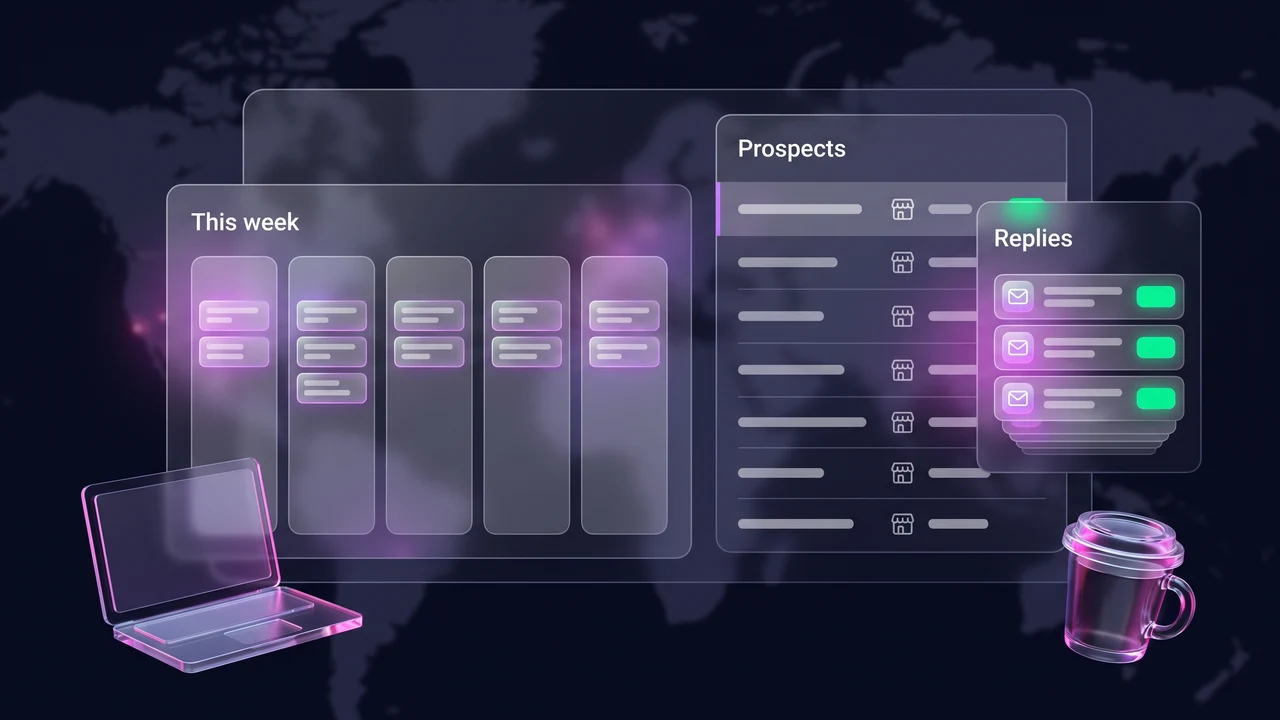
Take ten businesses from the list each week. Each one gets up to five touches across the week, then goes into a "later" pile whether or not they replied. This keeps the work bounded and stops you from chasing one business for a month.
| Day | Touch | What it contains |
|---|---|---|
| Monday | First email | One thing you noticed, one sentence on why it matters, one small ask |
| Tuesday | Phone call | Ask for the owner by name, refer to the email, ask one question |
| Wednesday | Second email | A new reason to reply: a short idea, an example, a relevant question |
| Thursday | Second call or a visit | For shops and restaurants, a quiet-hour visit beats a second call |
| Friday | Closing note | A polite last message that leaves the door open and stops |
Stop immediately if someone says no or asks not to be contacted, and record it so you never contact them again.
The first email is the hard one. Use the structure in cold email templates for local businesses and rewrite the first line for every business. For the calls, the cold calling script for local businesses covers how to get past the front desk and what to say in the first ten seconds.
Rules for contacting businesses by email and phone differ by country, and the contact details of a sole trader can count as personal data because they identify a person. This is not legal advice; read is Google Maps scraping legal and follow the rules where you and the business are.
Price small packages
Hourly rates make small business owners nervous, because they cannot see the total. A package has a name, a fixed scope, a fixed price and a delivery time. It is easier to say yes to, easier to refer and easier to deliver.
- A small one that solves the thing you noticed on their site: one page rewritten, a menu redesigned, a form fixed, a month of books caught up.
- A standard one that covers the obvious next step: a five-page site's copy, a brand refresh, a booking integration, a monthly bookkeeping service.
- An ongoing one billed monthly: content, updates, maintenance, admin hours. This is where a freelance income becomes stable.
For each package write one page: what is included, what is not, what the client supplies, timeline, price and deposit. Take the deposit before you start; it filters out people who are not serious. Price the small package so a single new customer for the client would cover it, and revise after three sales.
A portfolio with two real projects
Nobody hires a freelancer with an empty portfolio, and a portfolio of mock-ups persuades nobody. Two finished projects for real businesses, with permission to show them and a quote from the owner, are enough. If you have none, do two projects for a reduced fee or for a local cause, in exchange for that permission in writing.
Write each one up as a short case: what the business needed, what you did, and what changed. Only state what you can show. If you do not have a measurable result, describe the work and let the owner's words carry it. Never invent a number or a quote.
Then make yourself findable. A one-page site with your buyer type in the headline, a Google Business Profile for your own service, and a profile on the network your buyers use. When an owner checks you after your email, they should find exactly what the email said.
Referrals and repeat work
Ask for a referral at the end of every project, while the client is pleased. Make the question narrow: "Who else do you know who runs a clinic and has been meaning to sort out their website?" Then write the two-line introduction so all they have to do is forward it.
Repeat work is cheaper than any outreach. At handover, offer the ongoing package. A freelancer with six clients on small monthly packages has a business; one with sixty one-off projects has a job search.
Your first month, week by week
- Week 1: choose the buyer type, build and hand-check the list of fifty, write your three package pages, and set up the tracking sheet.
- Week 2: run the five-touch week on the first ten businesses. Message five people who already know your work and ask for one introduction each.
- Week 3: run it on the next ten. Hold discovery calls with anyone who replied and send a package page the same day.
- Week 4: run it on the next ten. Review the sheet: which first lines got replies, which channel got the conversation, what objections came up.
By the end of the month you will have contacted thirty businesses properly, and you will know something about your market that no guide can tell you. Adjust the message, the package or the buyer type based on what you saw, and start the next fifty.
Start Finding Verified Leads Today
Extract verified emails, phone numbers, and social links from Google Maps. Start with a 7-day Starter trial (1,000 leads included) and keep 100 free leads every month forever after. No credit card required.
Instant setup · No credit card required · 100 free leads/mo forever after
Related articles
How to Find B2B Clients When Your Customers Are Local Businesses
One method for any service, from cleaning to IT support, with links to trade-specific guides.
12 Cold Email Templates for Local Businesses (Copy, Paste & Personalise, 2026)
Local business owners ignore generic pitches. These twelve templates each open with a specific, verifiable observation about the prospect's own business.
Cold Calling Local Businesses: A Script, Call Flow and Objection Answers
Prepare in two minutes, open with something specific and handle the objections you will hear most.
Frequently asked questions
Do one or two projects for a reduced fee or for a local cause in exchange for written permission to show the work and quote the owner. In parallel, pick one local business type, build a list of fifty, and contact ten a week with a specific observation about each. The first paying client usually comes from that list or from someone you already know.
Both can work. Job boards and marketplaces bring early work and reviews but push prices down and put you against everyone. Local businesses reached directly are less crowded, pay in your currency and refer each other. Many freelancers use boards for the first few jobs and then move to direct work.
Ten, properly, is a good number for one person. Each gets a personal first email, a call, a follow-up with a new reason to reply, a second call or visit, and a closing note. Thirty or forty a week with a template first line usually gets fewer replies than ten with a real one.
Offer named packages with a fixed scope, price and delivery time rather than an hourly rate, and take a deposit before starting. A small package, a standard one and a monthly one cover most needs. Price the small one so a single new customer for the client would pay for it.
It depends on the country and on whether the address identifies a person, as a sole trader's often does. Business-to-business messages are treated differently from consumer marketing in many places, but rules on consent, opt-outs and identification still apply. This is not legal advice, so check the rules where you and the business are located.