
How Recruitment Agencies Find Local Employers Who Need Staff
Key takeaways
- A recruitment agency's clients are employers. For local and regional agencies, most of them are businesses that appear on Google Maps.
- Focus on trades and sectors where you already place candidates, and on businesses that plausibly hire often, such as clinics, restaurants, warehouses and construction firms.
- A list of businesses does not show who is hiring. Check each employer's careers page and job boards to find real vacancies before you call.
- Lead with a candidate or a vacancy you can actually help with, not with your agency's credentials.
Most agencies win business in two ways: employers come to them, or they go to employers. The second route depends on knowing who to call and having something relevant to say when you do.
This guide shows how to build a list of local employers by sector, how to find out whether they are hiring, whom to contact, and how to make a first approach that employers do not delete.
Start from the candidates you can place
Prospecting works best when you can name a candidate or a type of candidate you can supply. Before you build any list, write down the roles you place well, the areas you cover and the sectors those roles sit in. A pitch that says "I have two qualified electricians available in {City} this month" gets a different reception from "we are a full-service recruitment agency".
Choose sectors that hire
| Sector | Typical roles | Why it may need agency help |
|---|---|---|
| Healthcare and dental | Nurses, dental nurses, receptionists, practice managers | Ongoing demand, specific qualifications |
| Hospitality | Chefs, servers, front of house | High turnover and seasonal peaks |
| Construction and trades | Electricians, plumbers, labourers, site managers | Project-based demand |
| Logistics and warehousing | Drivers, forklift operators, pickers | Peaks and shift work |
| Professional services | Admin, accounts, junior staff | Small firms with no HR team |
| Retail | Sales staff, managers | Seasonal and turnover-driven |
These are typical patterns, not guarantees. Concentrate on sectors where you have candidates and knowledge.
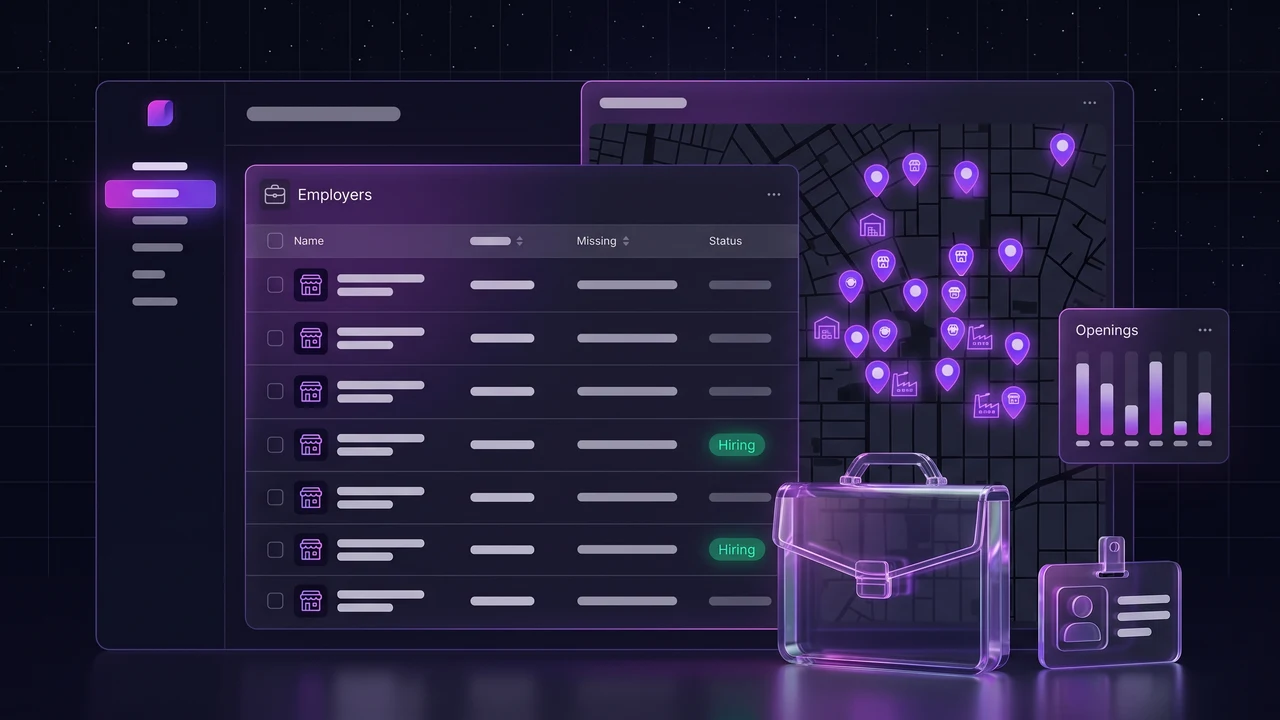
Build a list of employers from Google Maps
- Run a search for the sector in your area, for example
dental practice Leicesterorwarehouse Leicester. - In LeadOutreach, filter for Has website so you can check the careers page, and for Has phone so you can call.
- Use a minimum rating to concentrate on established employers.
- Use the review count as a rough guide to size and activity.
- Export and add columns for the contact person, whether you found a vacancy, the date contacted and the outcome.
A list gives you the employers and how to reach them. It does not tell you who is hiring, which is the next step.
Find out who is hiring
- Open each employer's website and look for a careers or jobs page.
- Search the business name on the job boards you use and see whether it has current vacancies.
- Check their social pages for hiring posts.
- Look at the review text on their Google listing only for signs of staffing pressure, such as long waits, and do not collect or reuse personal information from it.
- Note vacancies that have been open for a long time. Those are the ones where an agency can help.
An employer with a long-open vacancy and no in-house recruiter is a strong prospect. An employer with no visible vacancies may still hire, but you have less to talk about.
Reach the person who hires
In a small business it is the owner or manager. In a larger one it may be an HR manager, a site manager or a department head. Ask when you call: "Who looks after hiring for {role}?" A name is a good outcome from a first call.
For call structure and objection answers, see the cold calling script.
The first message
Example email
Subject: {role} for {Business}. Hi {Name}, I saw {Business} has been advertising for a {role} since {Month}. I work with local {sector} businesses and have two candidates in {City} with the right experience who are available now. If it would be useful, I can send their summaries today with no obligation. {Your name}, {Agency}, {phone}.
- Refer to a real vacancy or a real candidate you have.
- Protect candidates' privacy. Share summaries only with their permission.
- Be clear about your terms when they ask, in plain language.
- Include your contact details and an easy way to opt out.
Rules on unsolicited email and calls, and on handling candidate data, vary by country. Check the ones that apply to you. This is general information, not legal advice. For email structures, see cold email templates for local businesses.
Keep the relationship
- Ask each employer what kind of roles they expect over the next six months.
- Follow up after a placement, and again after the candidate's first month.
- Ask for a Google review and a referral to a business they know.
- Log everything so the next call starts where the last one ended.
For the wider method of selling to local businesses, see how to find B2B clients when your customers are local businesses.
Start Finding Verified Leads Today
Extract verified emails, phone numbers, and social links from Google Maps. Start with a 7-day Starter trial (1,000 leads included) and keep 100 free leads every month forever after. No credit card required.
Instant setup · No credit card required · 100 free leads/mo forever after
Related articles
How to Find B2B Clients When Your Customers Are Local Businesses
One method for any service, from cleaning to IT support, with links to trade-specific guides.
Cold Calling Local Businesses: A Script, Call Flow and Objection Answers
Prepare in two minutes, open with something specific and handle the objections you will hear most.
Local Business Lead Generation: How to Find & Generate Leads
Local business directories hold the contact info of 200M+ businesses. Here is the exact process to turn them into verified, AI-scored sales leads.
Frequently asked questions
By building lists of local employers in the sectors they place candidates in, checking who is hiring from careers pages and job boards, contacting the person who handles hiring with a relevant candidate or vacancy, and building referrals from satisfied employers.
Yes. Searching for a type of business in your area gives you names, addresses, phone numbers and websites, and a lead tool can add emails. It does not show who is hiring, so check careers pages and job boards next.
In a small business, the owner or manager. In a larger one, an HR or people manager, a department head or a site manager. Ask by phone who looks after hiring for the specific role.
It is normal sales activity, but rules on calls, email and personal data vary by country. Include your details, honour opt-outs and check the rules where you operate. This is general information, not legal advice.
Mention a real vacancy or a real candidate profile, offer to send summaries with no obligation, and keep it to a few sentences with your contact details.